

What Artificial Intelligence Really Means in 2026
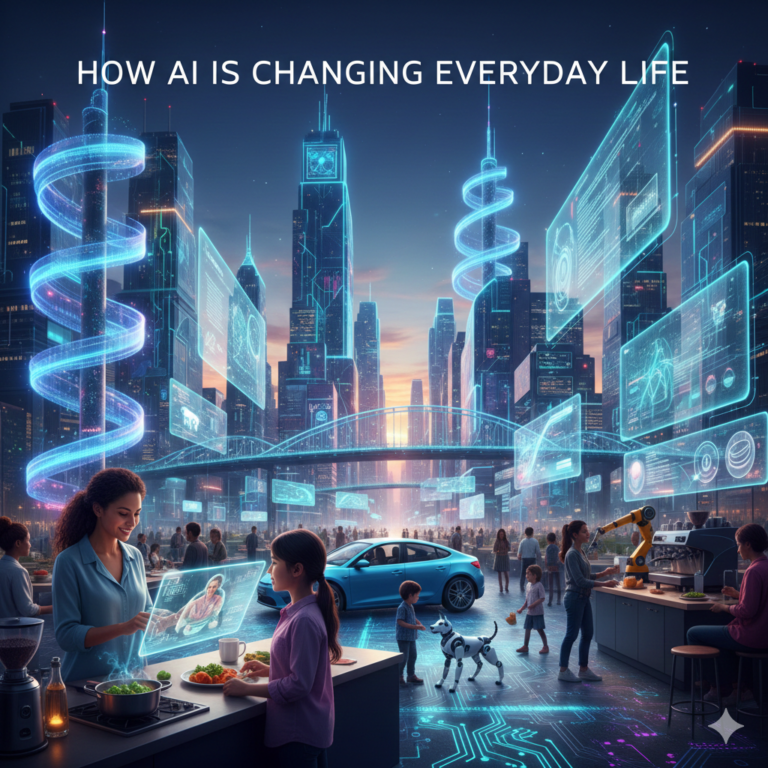
Artificial Intelligence in 2026 is no longer a futuristic concept—it is an operational layer of modern life. At its core, Artificial Intelligence refers to computer systems designed to perform tasks that traditionally required human intelligence, such as understanding language, recognizing images, making decisions, and predicting outcomes. However, the definition has evolved. Today, AI is less about mimicking humans and more about amplifying human capability. It operates through mathematical models trained on massive datasets, identifying patterns and relationships that would be impossible for a person to process manually. The most important shift is that AI is no longer confined to research labs or tech giants; it is embedded in browsers, smartphones, business software, healthcare diagnostics, logistics systems, and creative tools.
What makes Artificial Intelligence in 2026 different from previous years is its accessibility and autonomy. Modern AI systems can interpret complex instructions in natural language, generate original content, and adapt to new contexts without explicit reprogramming. This is largely driven by foundation models—large neural networks trained on diverse, multimodal data including text, images, audio, and video. These models serve as a base layer that can be specialized for thousands of applications. For example, when you ask an AI assistant to summarize a report, it does not search for a prewritten summary. Instead, it dynamically generates a new one based on its understanding of language and context.
Another defining aspect is that AI has become an interface, not just a tool. People are no longer clicking through menus; they are talking to systems. This conversational layer is changing how software is designed. Instead of learning how to use software, software learns how to understand you. Companies like OpenAI (https://openai.com), Google DeepMind (https://deepmind.google), and Anthropic (https://www.anthropic.com) are leading this shift by building systems that function as reasoning engines rather than simple automation scripts. Artificial Intelligence in 2026 is not just executing commands—it is interpreting intent.
How Artificial Intelligence Works: The Real Mechanics Behind the Magic
Despite how natural AI feels today, its operation is grounded in mathematics, statistics, and computational scale. The backbone of modern AI is machine learning, particularly deep learning, which uses artificial neural networks inspired loosely by the structure of the human brain. These networks consist of layers of interconnected nodes that transform input data step by step until a useful output is produced. During training, the system adjusts billions or even trillions of parameters to minimize errors. This process allows the AI to learn patterns, not memorize answers.
One of the most important breakthroughs enabling AI in 2026 is the transformer architecture, introduced in 2017 but massively expanded since then. Transformers allow AI models to understand relationships between words, pixels, or sounds regardless of their position. This is why modern AI can maintain context across long conversations or generate coherent articles. Instead of processing information sequentially like older models, transformers process information in parallel, making them both faster and more effective. This architecture powers most generative AI systems today.
Another critical component is inference, which is the phase where the trained AI actually produces results. When you interact with an AI, it is not thinking in a human sense. It is calculating probabilities—predicting what word, pixel, or action should come next based on patterns learned during training. For example, when generating text, the AI predicts the most statistically appropriate next word thousands of times per minute. The result feels creative, but underneath, it is advanced prediction at scale.
Equally important is the role of data and feedback. Modern AI systems improve through fine-tuning and reinforcement learning, often guided by human feedback. This process aligns the AI’s outputs with human expectations, making responses more useful, safe, and relevant. Hardware also plays a huge role. Specialized processors such as GPUs and AI accelerators make it possible to run these massive models efficiently. Without advances in computing power, the current generation of AI would not exist.
In 2026, another major shift is happening: AI is moving from static models to adaptive systems. Instead of being trained once and deployed, AI systems can now integrate real-time information, use external tools, and perform multi-step reasoning. This makes them capable of assisting with complex workflows such as coding, research, financial analysis, and strategic planning. AI is no longer just a prediction engine; it is becoming an execution partner.
What Artificial Intelligence Really Feels Like in Practice
From my experience, Artificial Intelligence in 2026 feels less like using software and more like collaborating with something that extends your thinking. The biggest difference I’ve noticed is speed—ideas that used to take days now take hours, and tasks that required teams can be started alone. But the real power isn’t automation; it’s clarity. AI helps you see options, structure thoughts, and move forward faster. The key, in my opinion, is not to see AI as a replacement, but as leverage. The people who win with AI aren’t the ones who know everything about it technically—they’re the ones who learn how to use it strategically. And once you experience that shift, it’s very hard to go back to working without it.