
The Rise of Digital Pills and AI-Powered Health Monitoring
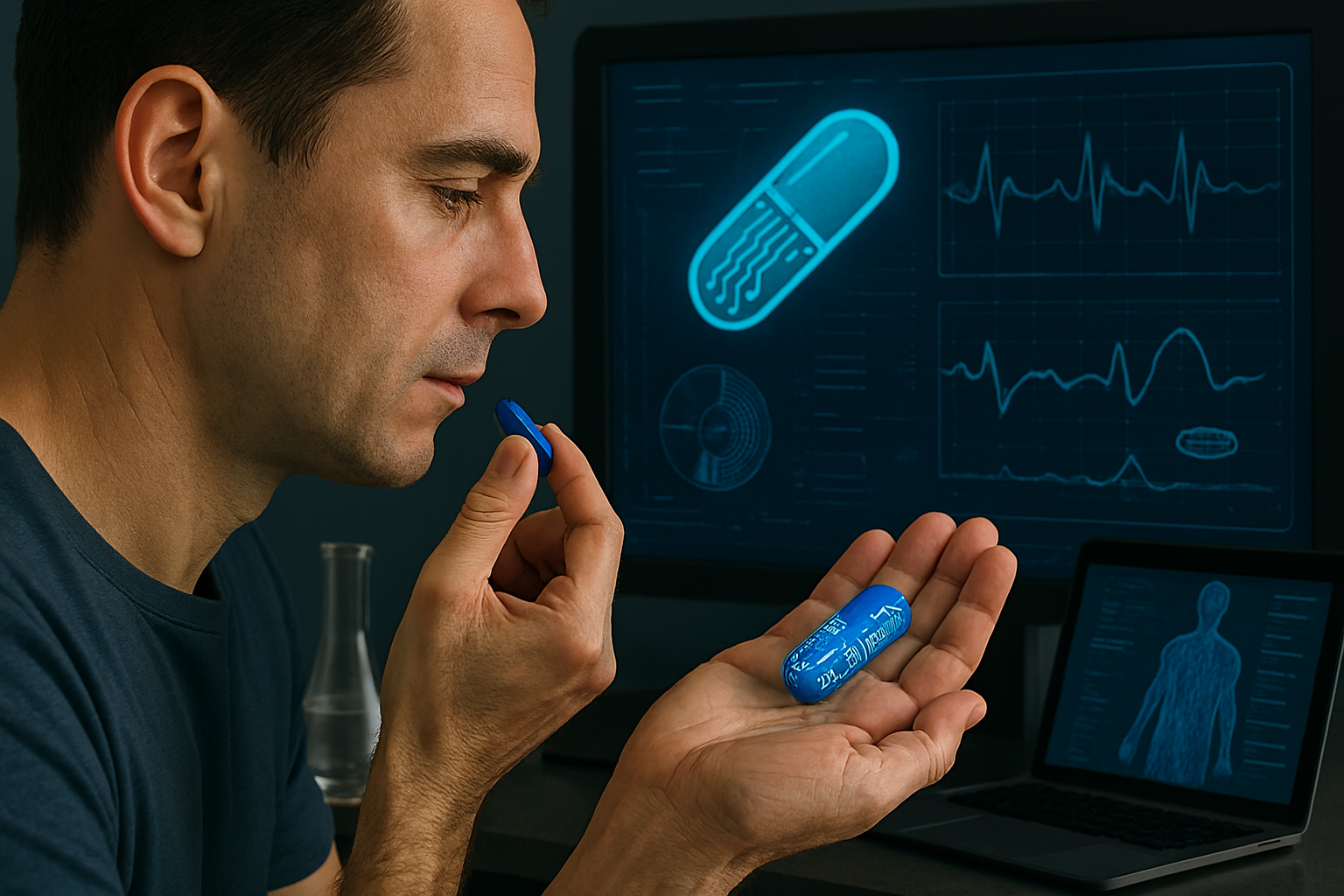
The idea of swallowing a pill that doesn’t just treat your body but also communicates data about your health used to sound like science fiction. Today, digital pills, also known as smart pills, are a real and rapidly evolving innovation at the intersection of artificial intelligence in healthcare, biosensors, and remote patient monitoring. These ingestible devices contain tiny sensors that activate when they reach the stomach, sending signals to wearable patches, mobile apps, and cloud-based AI systems that analyze patient behavior, medication adherence, and physiological responses in real time.
This technology represents a shift from reactive medicine to predictive and proactive healthcare, where AI algorithms can detect patterns before symptoms become serious problems. For example, companies like Proteus Digital Health pioneered FDA-approved digital pills designed to track whether patients take their medications correctly, helping doctors monitor treatment adherence for conditions like mental illness, cardiovascular disease, and diabetes. You can explore how this works directly from the FDA’s official overview:
https://www.fda.gov/medical-devices/digital-health-center-excellence
What makes this revolutionary is not just the sensor itself, but the AI layer behind it. Artificial intelligence processes massive amounts of patient data continuously, identifying trends, anomalies, and risks that human observation alone would never catch in time. Instead of relying on occasional checkups, healthcare becomes a continuous feedback loop powered by machine learning.
How Smart Pills Use AI to Transform Personalized Medicine
At their core, AI-enabled digital pills combine three technologies: ingestible sensors, wearable devices, and machine learning platforms. Once swallowed, the sensor interacts with stomach fluids, generating a signal that confirms ingestion. This signal travels to a wearable patch, which collects additional biometric data such as heart rate, physical activity, and sleep patterns. The data is then transmitted to secure cloud platforms where AI algorithms analyze patient-specific health patterns.
This creates what many experts call hyper-personalized medicine, where treatment is no longer based on general population averages but on each individual’s real-time biological behavior. For instance, AI can identify whether a medication is causing side effects, whether a patient is responding positively, or whether adjustments are needed. This level of precision has enormous implications for chronic diseases, mental health treatment, and elderly care.
Major technology and healthcare companies are investing heavily in this space. Google, through its health research divisions, has explored ingestible sensors and AI diagnostics, while startups continue to innovate rapidly. The National Institutes of Health also provides research insights into digital health technologies:
https://www.nih.gov/health-information
What stands out is that AI doesn’t just collect data it interprets meaning, turning raw biological signals into actionable medical intelligence.
Why Digital Pills Could Redefine the Future of Healthcare
One of the biggest problems in medicine has always been uncertainty. Doctors rely on patient self-reporting, memory, and occasional measurements. But memory is imperfect, and health is constantly changing. Digital pills eliminate this gap by creating a continuous, objective stream of health data.
This changes everything about prevention. AI systems can detect early warning signs of deterioration long before traditional diagnosis would be possible. Imagine identifying depression relapse patterns early, predicting cardiac events before they happen, or optimizing medication timing based on your unique biological rhythms. This isn’t just monitoring it’s anticipating health events before they occur.
There are also economic implications. Healthcare systems worldwide struggle with rising costs and hospital overload. AI-powered digital pills could reduce hospitalizations, improve treatment success rates, and make healthcare more efficient overall.
But perhaps the most important shift is philosophical. Healthcare moves from being something you visit occasionally to something that lives with you continuously.
Where AI, Humans, and Digital Pills Begin to Merge
The first time I saw how a simple sensor could confirm medication intake and instantly generate insights through AI, it completely changed how I understood healthcare. It didn’t feel like technology assisting medicine it felt like medicine becoming intelligent. The distance between the human body and digital systems was suddenly much smaller, almost invisible.
What’s becoming clear is that AI is not just analyzing health it’s becoming part of the health process itself. The body generates signals, sensors capture them, and AI interprets them, creating a loop of awareness that never existed before. It’s no longer about guessing how a patient feels days later; it’s about knowing, continuously and precisely.
And honestly, it’s hard not to feel a sense of anticipation thinking about where this leads next a world where silent signals inside the body are understood instantly, where invisible problems are caught early, and where healthcare stops being something reactive and becomes something deeply connected, always present, and always learning.