
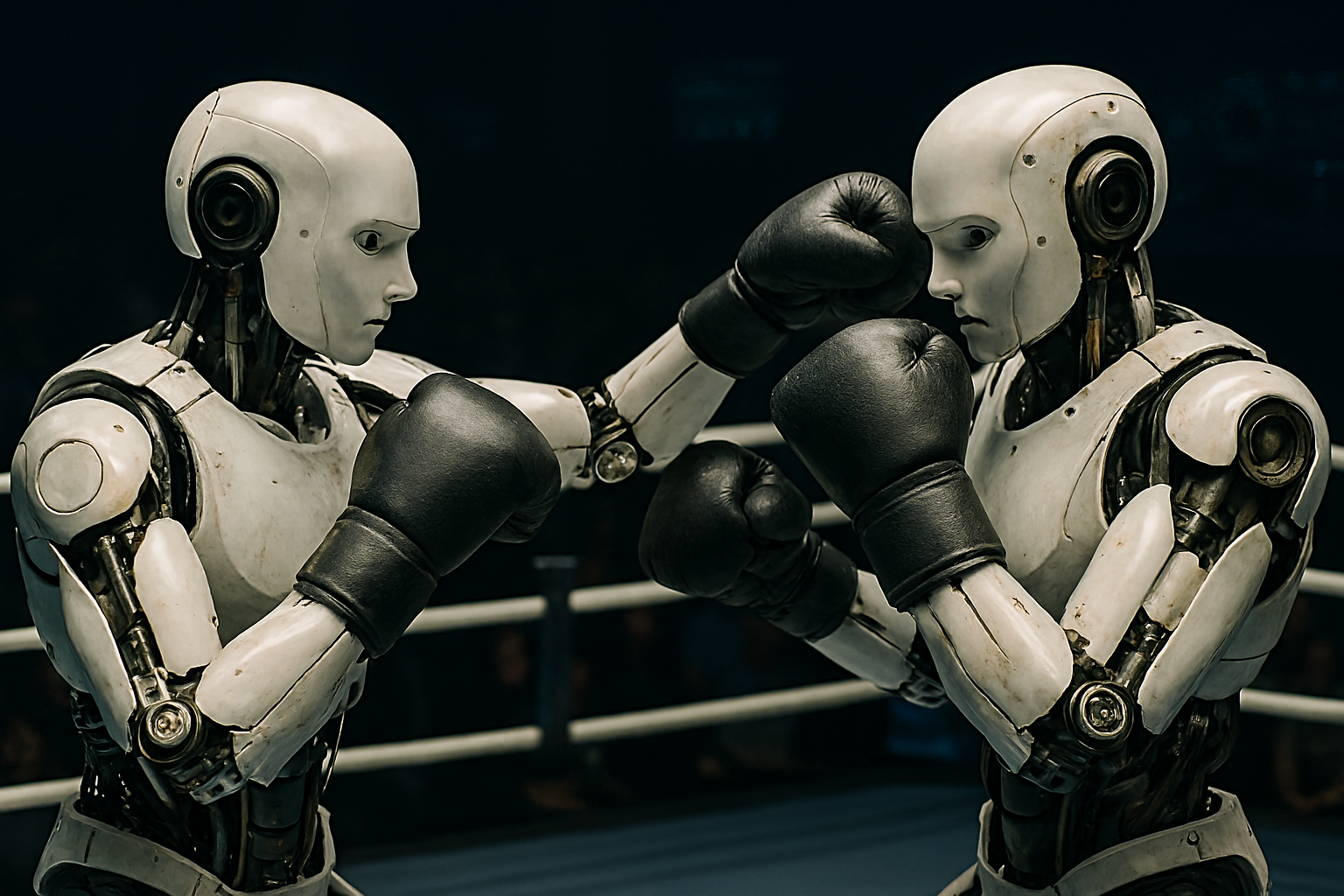
Artificial intelligence is no longer confined to screens, chatbots, or recommendation systems. It is stepping into the physical world with speed, balance, and decision-making capabilities that were unthinkable just a decade ago. One of the most fascinating and symbolic frontiers of this evolution is AI martial arts robots machines capable of learning, adapting, and executing combat movements inspired by disciplines like karate, taekwondo, and kung fu. This convergence of robotics, reinforcement learning, and martial arts is not just a technological curiosity; it represents a fundamental shift in how machines understand movement, strategy, and interaction.
Humanoid Robots Learning Martial Arts Through Reinforcement Learning
The most important breakthrough behind martial arts robots is reinforcement learning in robotics, a branch of AI that allows machines to learn through trial and error, much like a human fighter refining techniques through sparring. Instead of being programmed with fixed movements, modern humanoid robots are trained in simulated environments where they practice balance, timing, and reaction thousands or even millions of times faster than any human could. Companies like Boston Dynamics and Unitree Robotics have demonstrated robots capable of dynamic kicks, rapid recovery after being pushed, and fluid motion that resembles trained athletes more than machines. These capabilities are powered by neural networks that constantly optimize movement efficiency, energy use, and stability. A useful example can be seen in Unitree’s humanoid robots: https://www.unitree.com. What makes this especially significant is that martial arts require far more than strength they require balance, anticipation, and adaptation. When a robot can adjust its posture in real time after an unexpected disturbance, it proves that AI is not just executing commands; it is making decisions based on physical reality. This is the same core principle behind autonomous vehicles and advanced prosthetics. Martial arts simply make it visible in a dramatic and intuitive way. In essence, AI martial arts training is a real-world stress test for machine intelligence, forcing algorithms to deal with uncertainty, timing, and physical risk.
Why Martial Arts Are the Ultimate Benchmark for Physical AI
Martial arts are uniquely suited to push the limits of physical artificial intelligence because they combine biomechanics, strategy, and perception into a single activity. Walking in a straight line is predictable; fighting is not. Every movement from an opponent introduces chaos, forcing instant adaptation. This is why researchers increasingly use combat-like scenarios to test robot agility, reflexes, and coordination. Google DeepMind, for example, has published research on AI agents that learn complex motor control in simulated physics environments: https://deepmind.google/research. These systems must learn when to strike, when to retreat, and how to maintain stability while transferring force through the body. From a robotics engineering perspective, this requires integrating multiple AI systems at once: computer vision to perceive motion, reinforcement learning to make decisions, and motor control algorithms to execute precise physical actions. The SEO keyword phrase “AI robots learning martial arts” may sound futuristic, but the underlying technology is already influencing industries like warehouse automation, disaster response, and healthcare robotics. A robot that can maintain balance during a kick can also maintain balance while carrying fragile medical equipment or assisting a patient. Martial arts accelerate progress because they expose weaknesses quickly. If the robot fails, it falls. If it falls, the algorithm learns. This rapid feedback loop is exactly what drives exponential improvement. The result is a new generation of machines that move less like tools and more like physical agents capable of interacting with the world dynamically.
The Moment Machines Begin to Move With Intention
Watching these robots train doesn’t feel like watching code run; it feels like watching something discover its body for the first time. There is a moment when the movement stops looking mechanical and starts looking deliberate, when balance corrections happen instantly and motion flows instead of stutters. It becomes easy to imagine training centers where robots and humans refine techniques side by side, not as replacements but as partners in exploration, pushing the limits of what movement can be. The same intelligence that learns a kick today will learn to assist, protect, and collaborate tomorrow, and the line between programmed motion and learned skill will keep fading until the distinction barely matters. What stands in front of us is not just better robots, but a new kind of physical intelligence entering the world and it’s impossible not to feel the momentum building toward something extraordinary.