

The American financial system places an immense emphasis on credit history, making a well-chosen credit card an indispensable tool for establishing financial stability, accessing competitive loan rates, and unlocking valuable rewards. For both established residents and newcomers to the United States, understanding the landscape of credit cards is the first critical step toward financial success.
Part I: The Best Credit Cards for Established U.S. Residents
For those with a Good (670-739) to Excellent (740+) credit score, the market offers high-value rewards cards tailored to different spending habits: Cash Back, Travel Rewards, and Flexible Points.
1. Best for Flat-Rate Cash Back (Simplicity and High Return)
These cards are ideal for consumers who prefer simplicity and do not want to track rotating categories.
| Card | Rewards Rate & Benefits | Annual Fee | Standout Specification |
| Citi Double Cash® Card | 2% cash back on every purchase (1% when you buy, 1% when you pay). | $0 | Excellent balance transfer option, allowing easy consolidation. |
| Wells Fargo Active Cash® Card | Unlimited 2% cash back on purchases. | $0 | Strong introductory cash bonus and cellular phone protection. |
Comparison: Citi Double Cash vs. Wells Fargo Active Cash
Both offer a market-leading 2% effective return. The Citi Double Cash is often preferred by those with large existing balances due to its typically longer introductory 0% APR on balance transfers. The Wells Fargo Active Cash is simpler (2% earned immediately) and includes additional benefits like cell phone protection (subject to terms).
2. Best for Flexible Travel Rewards (High-Value Points)
These cards offer high rewards rates on travel and dining, and their points can be transferred to airline and hotel partners for maximum value.
| Card | Rewards Rate & Benefits | Annual Fee | Standout Specification |
| Chase Sapphire Preferred® Card | 3x points on dining and streaming; 2x on general travel. Points are worth 25% more when redeemed through the Chase portal. | $95 | High sign-up bonus; points are highly flexible (Chase Ultimate Rewards ecosystem). |
| Capital One Venture X Rewards Credit Card | 2x miles on all purchases; 5x on flights booked via Capital One Travel; 10x on hotels. | $395 | Premium perks like airport lounge access and annual travel credits effectively reduce the annual fee. |
Advantage: The Points Ecosystem
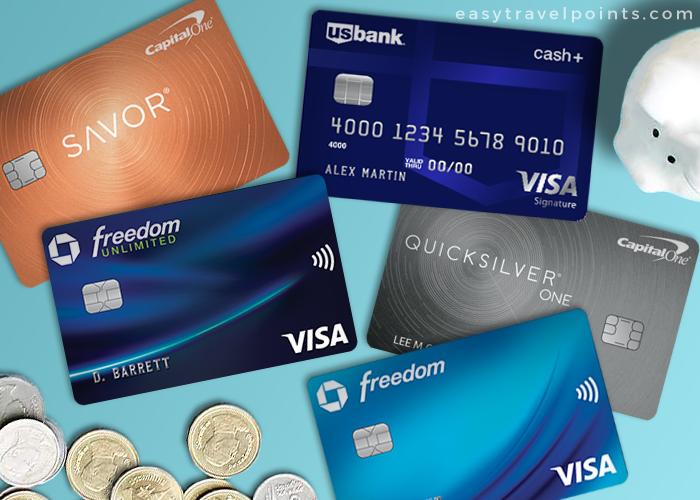
Cards like the Chase Sapphire Preferred gain immense value because they use a flexible points system (Ultimate Rewards). Cardholders can combine points from no-annual-fee cards (like the Chase Freedom Unlimited) and transfer them to airlines like United or hotels like Hyatt, often achieving a value far exceeding 2 cents per point.
3. Best for Categorized Cash Back (Everyday Spending)
| Card | Rewards Rate & Benefits | Annual Fee | Standout Specification |
| Blue Cash Preferred® Card from American Express | 6% cash back at U.S. supermarkets (on up to $6,000 per year); 6% on select U.S. streaming services; 3% on transit/gas. | $0 introductory fee, then $95 | Unrivaled cash back rate for heavy grocery spending families. |
| Chase Freedom Unlimited® | 5% back on travel booked through Chase; 3% on dining and drugstores; 1.5% on all other purchases. | $0 | Ideal starter card for the Chase ecosystem; great combination of flat-rate and bonus categories. |
Part II: The Best Credit Cards for New Immigrants
Starting credit history in the U.S. is the single biggest challenge for newcomers. Since most U.S. banks cannot verify international credit history (the concept of a «Credit Score» is specific to the U.S.), immigrants must often start with secured cards or cards designed specifically for this demographic.
1. Secured Credit Cards (The Credit Builder Tool)
Secured cards require a cash deposit, which acts as collateral and usually sets the credit limit (e.g., a $200 deposit yields a $200 limit). This significantly reduces the bank’s risk, making approval easier.
| Card | Key Features for Immigrants | Pros | Cons |
| Discover it® Secured Credit Card | $0 annual fee; accepts ITIN (Individual Taxpayer Identification Number); offers rewards (2% back at gas/restaurants, 1% general). | Rewards program; automatic review for upgrade to unsecured card after 7 months. | Requires a cash deposit (min. $200). |
| Capital One Quicksilver Secured Cash Rewards Credit Card | $0 annual fee; accepts ITIN; earns 1.5% cash back on all purchases. | Excellent ongoing rewards rate for a secured card; generally low minimum deposit. | Rewards earned may not justify the deposit if spending is low. |
2. Cards for Immigrants Without SSN/ITIN
Some specialized financial institutions and programs cater to individuals who have just arrived and lack both an SSN and an ITIN, often using passports and visa documentation instead.
- Firstcard® Secured Credit Builder Card: Explicitly accepts applicants without an SSN (using a passport/visa). The focus is on credit building with 0% APR.
- Zolve Classic Credit Card: Targets international students and H1-B/L-1 visa holders. They use alternative documentation (pay slips, offer letters) to approve cards before the applicant arrives in the U.S.
3. Alternative Strategies for Newcomers
- Authorized User Status: Immigrants can ask a trusted U.S. family member or friend to add them as an «Authorized User» on their existing credit card account. This action can immediately add the family member’s positive credit history to the immigrant’s report (though the primary user remains responsible for payments).
- International Banking: Some large multinational banks (like Citibank or HSBC) may use an applicant’s existing positive credit history from their home country to approve them for a U.S. card. This is known as «Global Transfer» or «Global Banking.»
Part III: Essential Credit Card Specifications and Warning
Navigating the U.S. credit market requires meticulous attention to the fine print.
1. Key Terminology Comparison
| Term | Significance | Warning |
| APR (Annual Percentage Rate) | The interest rate charged if you carry a balance. Average for prime cards is 20-24%; store cards are often 29.99%+. | Always pay the statement balance in full to avoid paying any APR. |
| Annual Fee | A yearly fee charged to the card. It is worth paying only if the rewards or perks exceed the fee. | Avoid fees unless you receive premium benefits (e.g., lounge access). |
| Foreign Transaction Fee (FTF) | A fee (typically 3%) charged on purchases made outside the U.S. | Crucial for Immigrants/Travelers: Many premium cards (e.g., Chase Sapphire) and some secured cards (Discover, Capital One) have $0 FTF. |
| Sign-Up Bonus | A reward (cash or points) earned after meeting a specific spending requirement in the first few months. | A major factor in card value, but only spend what you would naturally spend to earn it. |
2. The Deferred Interest Trap
When evaluating store cards or special financing offers (common at furniture stores, for example), be wary of the phrase: «No Interest If Paid In Full By [Date]».
- This is not a true 0% APR. Interest is building up («deferred») from day one. If you miss the final payment, even by one dollar, all the interest accumulated retroactively will be charged to your account. This is a high-risk financing method that should be approached with extreme caution and a guaranteed payoff plan.
3. Credit Utilization Ratio (CUR)
- Definition: The amount of credit you are using compared to your total available credit (e.g., $100 balance on a $1,000 limit is a 10% CUR).
- Significance: This is the second most important factor in the FICO Score (after Payment History).
- Suggestion: To maintain a high credit score, aim to keep your Credit Utilization Ratio below 30% and ideally below 10% across all your credit accounts.
In summary, the best credit card in the U.S. is the one that aligns with your credit level and maximizes your spending habits, whether that means securing a high-value travel reward or simply building a stable, reliable credit foundation.